



The Law & Economics Center (LEC) serves as a nexus for academic research and education that focuses on the timely and relevant economic analysis of legal and public policy issues confronting judges and policymakers nationwide. Learn more.
Founded by Henry G. Manne at the University of Miami in 1974, the LEC moved to Emory University in 1980, and then to George Mason University Antonin Scalia Law School in 1986 when Henry Manne became dean (a historic move described here).
Last year, the Law & Economics Center (LEC) celebrated its 50th Anniversary, and this year the LEC is celebrating both George Mason’s 300th birthday and the 250th birthday of the nation. On Monday, December 8, 2025 , the LEC commemorated Mason’s birthday with a panel on The Un-Forgotten Founder: A Celebration of George Mason’s Legacy on the Occasion of His 300th Birthday. The nation’s birth will be commemorated with a special panel in the fall.
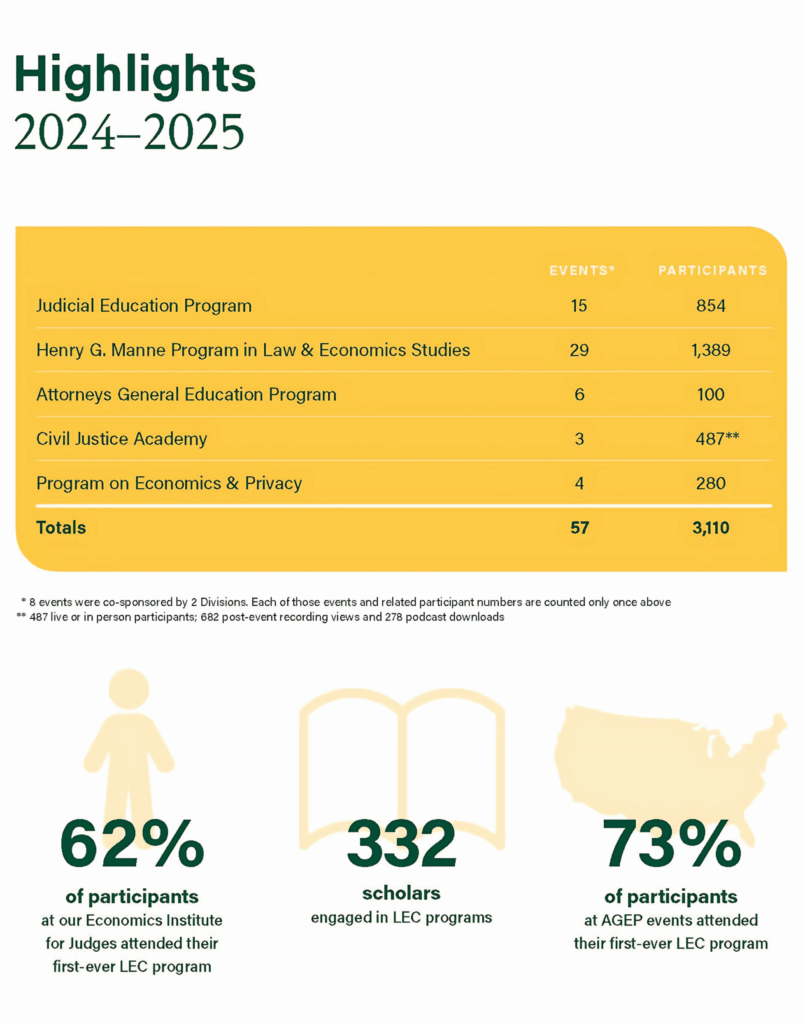
Law & Economics Center Divisions
The Law & Economics Center houses multiple divisions:
The Judicial Education Program is the nation’s preeminent provider of high-quality, balanced judicial education seminars and conferences that focus on economics, finance, accounting, statistics, and the scientific method.
The Henry G. Manne Program in Law & Economics Studies promotes law and economics scholarship by funding faculty research and hosting policy-relevant research roundtables and academic conferences.
The Attorneys General Education Program offers courses that provide broad-based understanding of economic and public policy issues to state attorneys general, state solicitors general, and their staff lawyers.
The Civil Justice Academy provides balanced educational programs on a range of civil litigation issues for the benefit of Members of the U.S. Congress, their staff, and their constituents.
The Program on Economics & Privacy produces timely and original economic analyses of the privacy, data security, competition, and consumer protection issues intrinsic to the modern, digital economy, and introduces this analysis into public policy discussions by generating education programs and hosting forums in which scholars, thought leaders, and policymakers can share research and insights.
The Program on Financial Markets fosters a rigorous understanding of how legal institutions evolve, interact, and influence the structure and operation of the financial system.
The Institute for Consumer Financial Choice is designed to (1) study markets and their impact on consumer choice; and (2) deploy rigorous research on testable questions involving consumer finance to educate current and future policy makers.
For the latest updates from the LEC, follow us on Twitter.